
The heat recovery device is the one AHU component that decides fan energy, plant footprint, infection-control risk and maintenance cost all at once, yet it is often picked by habit. Thermal wheel, counterflow plate or run-around coil: each can be the right answer, and each can be an expensive mistake in the wrong building.
The regulatory floor is the same for all three in one sense and different in another. Ecodesign Regulation 1253/2014 (retained in UK law) requires a non-residential bidirectional unit to reach 73% dry thermal efficiency, except run-around coils, which need 68%. Approved Document L Volume 2 (2026), para 5.63, adds no number of its own. It asks only that supply-and-extract systems have heat recovery where technically feasible.
Compliance is the minimum, not the selection criterion. What follows is how I weigh the three types commercially: capital cost, running cost, space, risk and what the client is left maintaining for 20 years.
Thermal wheels: the most recovery per metre of plant
A wheel delivers high efficiency in a short, compact casing, but it brings a moving part and a small, permanent transfer of extract air into the supply.
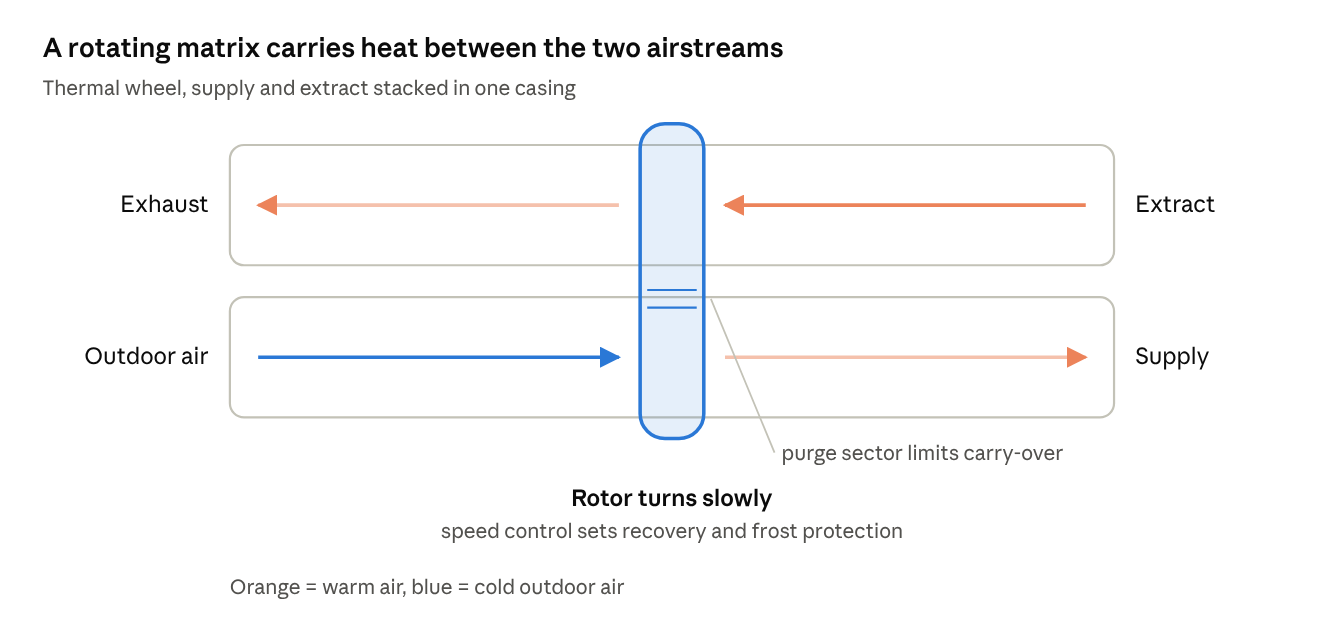
A rotor of corrugated aluminium matrix turns slowly through both airstreams. It soaks up heat on the extract side and gives it up on the supply side. Sorption-coated (hygroscopic) wheels move moisture as well as heat. A purge sector flushes the matrix with outdoor air before it rotates into the supply, which limits carry-over.
Benefits
High sensible efficiency, typically 75 to 85%, and the only one of the three that can recover latent heat. That can trim humidifier and chiller duty on a fully conditioned building.
Short airway length. Stacked supply and extract give the smallest footprint for a given efficiency, which matters on a roof or in a tight plantroom.
Good efficiency for its pressure drop, which keeps SFP down and helps the Part L fan power case.
Simple capacity control: rotor speed modulates recovery, and slowing the wheel is usually enough frost protection in the UK climate, so a frost preheater is rarely needed.
Scales well. On large units a wheel usually gives the best efficiency per pound of AHU.
Drawbacks
Carry-over. A few per cent of extract air reaches the supply, more if the fans are arranged wrongly or seals wear. The supply side must be held at higher pressure than the extract side.
Not for contaminated extract: commercial kitchens, labs, fume, pool halls with chloramines, or anywhere odour transfer will cause complaints.
A moving part: drive motor, belt, bearings and brush seals all need planned maintenance. Seal wear quietly increases leakage over the years.
Supply and extract must be co-located, which dictates plant and duct layout.
A stopped wheel still costs pressure drop in summer unless the unit has a bypass.
Commercial view. For offices, retail and education with clean extract and air handlers side by side, a wheel is often the best whole-life answer. In healthcare it is acceptable: HTM 03-01 (Part A, note to para 9.66) says the leakage is not aerobiologically significant, though plate exchangers are preferred for lower maintenance.
Counterflow plates: the highest dry efficiency and true separation
A counterflow plate gives the best dry efficiency of the three with no moving parts, but it is long, heavy at large sizes and needs a proper frost strategy.
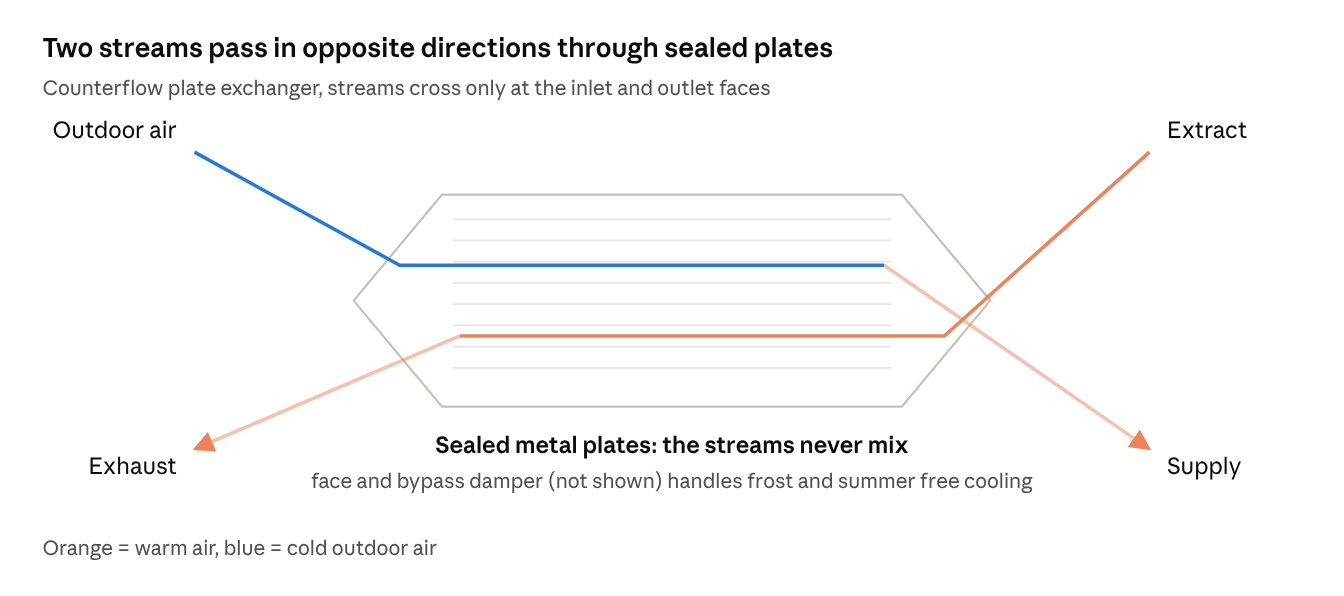
A pack of thin metal plates forms alternate sealed channels. Supply and extract run in opposite directions along a long counterflow section, so the leaving supply air approaches the extract temperature. This is a step change from the older crossflow plates that many existing buildings still run.
Benefits
Typically 80 to 90% dry efficiency, comfortably above the 73% ErP floor. Every point above 73% earns an SFPint allowance bonus under 1253/2014.
No moving parts. Maintenance is inspection and cleaning, and performance holds up over the plant's life.
Sealed channels mean leakage is negligible when the pressure regime is right, so odour and contaminant transfer is not a design risk.
An integral bypass damper gives free cooling with little pressure drop in summer.
The preferred option in healthcare: HTM 03-01 Part A (note to para 9.66) favours plates for their low maintenance, with metal plates only (para 9.18) and stainless steel preferred in coastal locations (para 9.68).
Drawbacks
Length and weight. High-efficiency cores are long in the airflow direction, so large AHUs get long, heavy and sometimes need splitting for delivery and lifting.
Frost. At high efficiency the extract side runs below 0°C in a UK winter. Face-and-bypass control sacrifices recovery; a preheat coil adds energy and capital cost.
Pressure drop is often higher than a wheel at the same efficiency, so check SFP rather than assume.
Sensible heat only, so no latent recovery for humidified spaces.
Needs a trapped condensate drain on the extract side, and supply and extract must still be co-located.
Commercial view. For small and medium AHUs where the units sit together, the plate is the low-risk default: mid-range capital cost, the lowest maintenance burden and no separation argument with the client. On a coastal South West site, budget for stainless or coated plates from the outset.
Run-around coils: the answer when the airstreams cannot meet
A run-around coil is the only one of the three that works with supply and extract plant apart, and the only one with total separation. It pays for that with the lowest efficiency and a hydronic system to maintain.
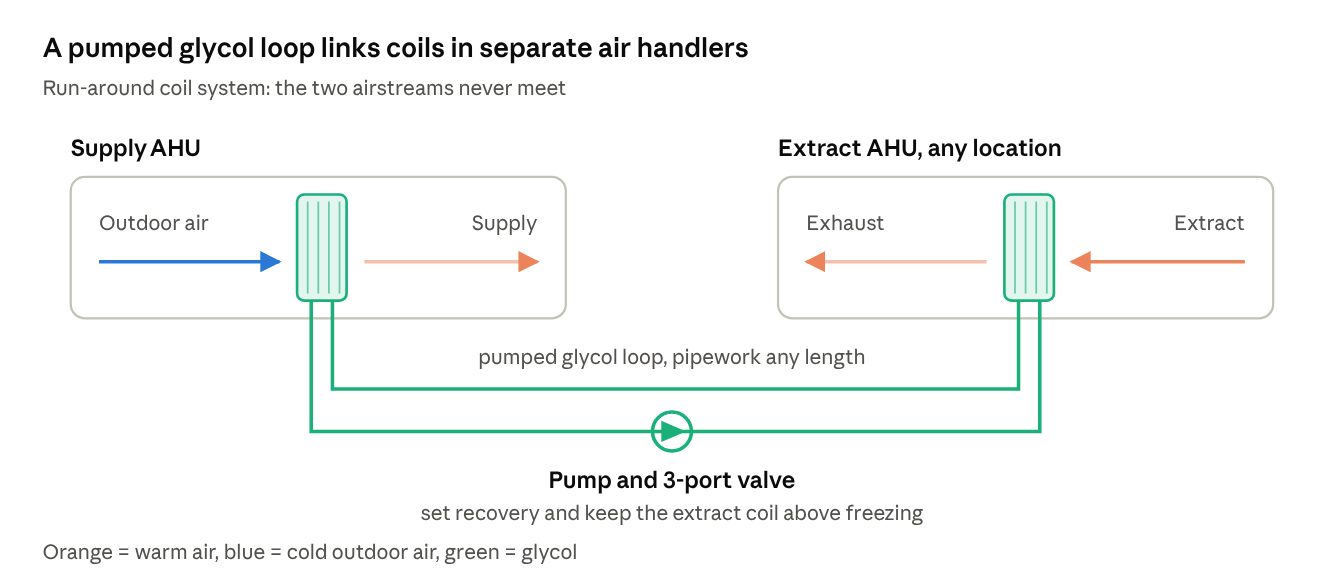
A finned coil in the extract picks up heat, and a pumped water-glycol loop carries it to a coil in the supply. A three-port valve or pump speed control modulates recovery and stops the extract coil freezing.
Benefits
Supply and extract can be in different plantrooms, on different floors or at opposite ends of a roof. Often the only option on a refurbishment where existing plant is already separate.
Complete separation, with zero carry-over. The safe choice for labs, fume extract, commercial kitchens (behind proper grease filtration), isolation suites and pool halls.
One loop can serve several supply or extract units.
Retrofit-friendly: coils can go into existing AHUs or duct sections.
Drawbacks
The lowest efficiency. Traditional selections sat around 45 to 60%. Reaching the 68% ErP minimum needs deep coils at low face velocity, which means bigger casings and more air pressure drop on both sides.
Pump energy on top of fan energy, which erodes the net saving and must be counted in the SFP and running-cost case.
A hydronic system to look after: pump, valve, expansion vessel, glycol strength checks and leak risk.
Two coils to clean, and fouling on a kitchen or dirty extract coil drops performance fast.
Sensible heat only.
Commercial view. Once pipework, pump, controls and commissioning are counted, the run-around coil usually has the highest capital cost per kW recovered. It is justified by layout or separation, not by efficiency. HTM 03-01 (note to para 9.66) reserves it for the same cases: separate units or space problems.
Side by side
No type wins on every count: the plate wins on risk and maintenance, the wheel on size and efficiency per pound, and the run-around coil on flexibility.
| Thermal wheel | Counterflow plate | Run-around coil | |
|---|---|---|---|
| Typical dry efficiency | 75 to 85% | 80 to 90% | 45 to 60%, 68%+ with deep coils |
| ErP minimum (NRVU) | 73% | 73% | 68% |
| Latent recovery | Yes, sorption wheel | No | No |
| Extract-to-supply transfer | Small, limited by purge sector | Negligible when sealed | None |
| Supply and extract together | Required | Required | Not required |
| Plant footprint | Compact | Long, heavy at large sizes | Two coils plus pipework |
| Frost protection | Slow the wheel | Bypass or preheat | Glycol and valve control |
| Moving parts | Rotor, motor, belt, seals | None besides dampers | Pump and valve |
| Maintenance burden | Medium | Low | Medium to high |
| Relative capital cost | Low to medium, best at large sizes | Medium | Highest per kW recovered |
| Best fit | Offices, retail, education, large AHUs | Healthcare, general use, small to medium AHUs | Labs, kitchens, refurbishment, split plant |
Efficiency ranges are typical dry values for current commercial AHU selections; always check the manufacturer's tested data at your own airflows.
How I would choose
Start with the plant layout, then the extract quality, and only then argue efficiency and cost. Most wrong selections come from doing it the other way round.
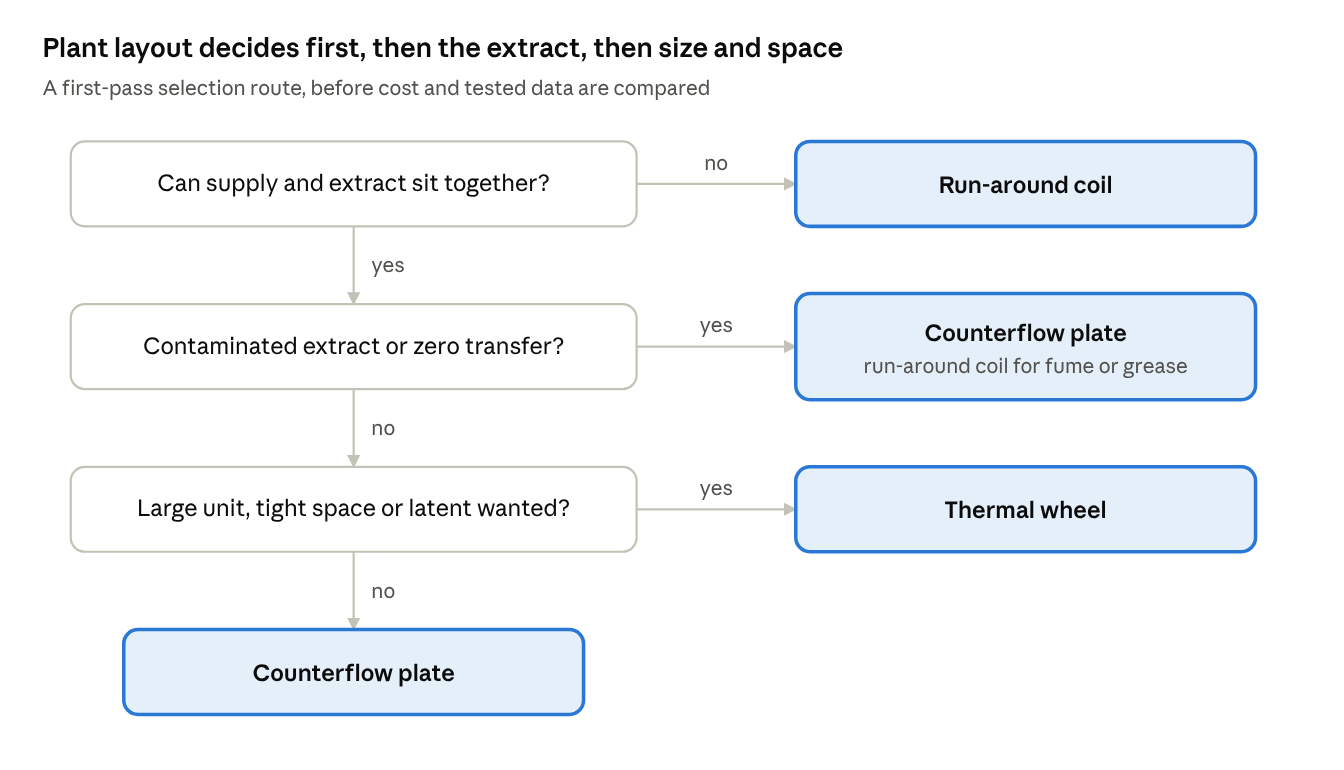
A few points I would hold any selection to:
Compare whole-life cost, not the AHU price. Add fan energy from the device's pressure drop, frost protection energy, pump energy and 20 years of maintenance. A cheaper device with an extra 100 Pa can cost more within a few years.
Ask for the right data. For wheels, ask for the exhaust air transfer ratio and confirm the fan arrangement keeps supply above extract pressure. For all three, ask for certified thermal efficiency at your airflows, not the brochure best case.
Design the frost strategy, do not inherit it. It decides how much of the rated efficiency you actually get on the coldest days.
Think about the client's maintenance team. A wheel or a glycol loop is fine with a good FM contract. On a site with limited maintenance, the static plate often protects performance best.
Heat recovery is now a given; choosing the right type is where engineering judgement still adds value. What is your default, and where has it caught you out?
References: Ecodesign Regulation (EU) 1253/2014 as retained in UK law; Approved Document L Volume 2, 2026 edition; HTM 03-01 Part A.